M22_ Castles, Farmlands, and Intelligence
Reclaiming the Infinite Home in the Age of AI. Exploring the convergence of architectural foresight, modern real estate economics, and the rising infrastructure of artificial intelligence. It challenges the "spiritual death" of the transient "chicken nugget lifestyle"—the processed, institutionalized renting model where wealth is sacrificed for growth and local market competition is replaced by the consistency of real estate cartels
REAL ESTATEREAL ESTATE, INTEREST RATES, AND ECONOMICSAI
7/12/20264 min read
My post content
The Spiritual Death of the "Chicken Nugget"
There is a specific kind of modern despair that comes from living in a world designed for the "exit." In a recent conversation with an observer of the decaying urban fabric, the term "chicken nugget lifestyle" was used to describe, in his opinion, the transient, processed, and ultimately soulless nature of modern institutional renting. We have reached a point where some would rather rent from a "soulless hedge fund" like BlackRock because at least the machine follows the lease, whereas the "Mom and Pop" landlord—clueless and cash-strapped—treats a leaky faucet as a personal financial catastrophe and the lease as an extension of the Red Cross.
This is a form of spiritual death. We have sacrificed wealth for growth, and in the process, we’ve traded the "build-it-yourself" Sears catalog homes of a century ago for overpriced rentals tethered to a broken monetary system. The market is flooded with sub-par-sub-10-unit landlords because the consistency offered by real estate cartels comes with the destruction of competitive local effects. This dynamic creates an "addiction cycle" where tenants feel forced to choose the cold predictability of a corporate machine over the volatility of professionalized small landlords who often treat basic maintenance as a "financial catastrophe".
While these real estate "cartels" offer the consistency of following a lease, they do so by importing consistent price growth into local markets, effectively strangling the price discovery and local competition that typically drive quality up and costs down. Squeezed from the opposite side, the sub-10-unit landlords are forced into becoming sub-par as the local government strips away their ability raise rents, deregulate, and or build additional units that actually pencil out without financial wizardry that would even make Madoff blush.
The result is a "chicken nugget" lifestyle—a processed, institutional substitute for real housing that thrives only because the healthy, organic market for independent local ownership has been sacrificed for globalized growth. To stay in the land of the living, we have to stop building for the next lease and political cycle and start building for the next century.
The Foundation: Lessons from a 173-Year-Old Elevator Shaft
When we talk about building for the future, we aren’t just talking about smart thermostats. We are talking about foresight as a structural element. In 1853, Peter Cooper began work on the Cooper Union Foundation Building in New York City. Long before Elisha Otis demonstrated a safe passenger elevator in 1854, Cooper instructed his architect to include a circular elevator shaft running the height of the building.
Cooper was an inventor who made his fortune in real estate and iron, even producing the very rolled-iron I-beams that supported the building’s floors. He didn't have a functioning elevator yet, but he knew the city would grow vertically and that his "pioneer building" needed to be ready for the technology that would eventually make skyscrapers possible. He was right about the need, even if he was slightly wrong about the shape—his shaft was round, while the industry eventually settled on rectangular cabs.
The lesson? To build a "castle" that lasts, you must design for the "elevator" of your era before it is even fully realized.
I wonder how many liberal arts degrees are aware that their education was seeded by a developer-landlord? The irony is not lost on me.
The Farmland Mindset: The Home as a Productive Asset
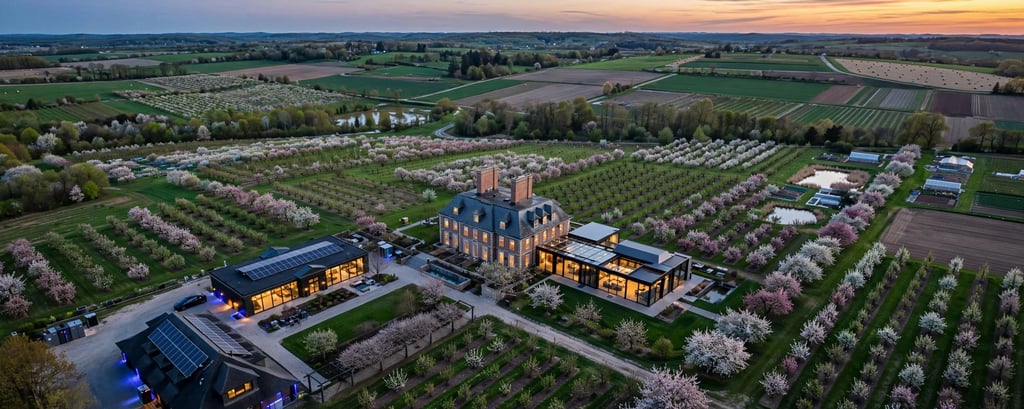
If the castle and its curtilage represent structural integrity and permanence—"Build it once. Sell it once. Live it infinitely"—then the "farmland mindset" is what makes that permanence affordable. A farm isn't just a place to sleep; it’s a productive asset that generates the very materials necessary for life.
In 2026, the "crop" of our farmland is compute. Compute is revenue, its scarcity is driven by the cost of electricity and the distance covered to deliver it.
We are seeing the first stirrings of this with the partnership between Nvidia, Span, and PulteGroup. They are beginning to install XFRA nodes—compact AI data centers about the size of an HVAC condenser—directly into residential backyards and onto the walls of new homes. These units tap into the spare electrical capacity of a home—which typically sits underutilized by as much as 58%—to run enterprise-grade AI workloads.
This isn't just a tech gimmick; it's a fundamental shift in real estate economics:
Wealth Generation: Homeowners hosting these nodes can see their total utility costs (electricity and internet) replaced by a flat monthly fee—sometimes as low as $150—while the provider pays the actual bills.
Infrastructure Upgrades: Participants receive high-end smart electrical panels, battery backups, and sometimes solar integration at no upfront cost.
Speed to Power: By distributing AI compute across thousands of homes, we bypass the 4-to-7-year delays required to build massive centralized data centers.
Conclusion: Building for Infinity
To solve the housing crisis, we must build everything, everywhere, all at once—but we must build it with the intention of confining wealth within our castle walls and within our families.
When we integrate AI infrastructure like XFRA nodes into the very fabric of our design, we are following Peter Cooper’s lead. We are building the "elevator shaft" for the 21st century. By turning a home from a passive drain on a family’s finances into a productive node in a global AI network, we create the economic floor that allows a home to be passed down rather than resold to the highest institutional bidder. In the not-too-distant future, savvy homeowners will benefit financially from capturing a slice of globalization in every prompt that is entered in ChatGPT. The San Francisco startup using Claude code will provide an upstate New York family with free electricity for a generation. Git pull requests power the EV parked in a Connecticut driveway. The institutional landlord will have to compete with the state-of-the-art Oregon duchy, whose offspring will not have to choose between pursuing contemporary urban higher education and remaining in the shadow of Mount Hood.
We must resist the spiritual death of the chicken nugget lifestyle. It’s time to build like castles, think like farmers, and design for the infinite.
For further discussions, inquiries or to delve deeper into this analysis, please feel free to get in touch.