M21_ The Davos Paradox – From Pop-Up Alpine Showrooms to 401(k) Front Doors
Every January, the quiet Alpine town of Davos transforms from a "white cereal bowl" of frosted gingerbread houses into a high-octane corporate "spectacle of the absurd". While the global elite discusses "Globalization 4.0," the local real estate market undergoes a temporary organ transplant. For those of us navigating the high-stakes world of property ownership, Davos offers a masterclass in how an extreme supply-demand mismatch can cannibalize a local economy—and a cautionary tale for our own attempts to solve the housing crisis at home.
Martin O.W. DuPain
1/19/20263 min read
The Landlord’s Jackpot
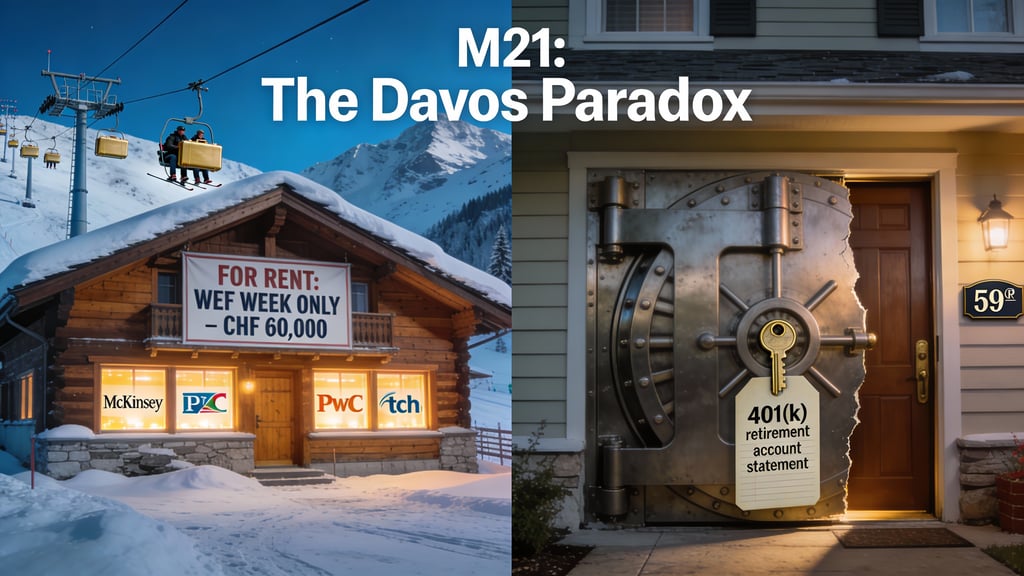
In Davos, the seasonal population swell creates a demand for space so immense that local businesses on the main promenade vacate their premises entirely to lease them out at exorbitant rates. This isn't just a bump in the books; for many, it represents a significant portion of their business revenue for the entire year.
The numbers are staggering. A lodge that normally rents for approximately $52,800 per week can command as much as $453,600 during the forum. Even non-traditional spaces are monetized: a bed in a showroom with no shower recently listed for $22,750 per week, while the most affordable Airbnb room with a shared bathroom reached $1,600. The windfall is so significant that many landlords reportedly keep housing units vacant for most of the year, as they can earn more in this single week than through regular year-round rentals. Even the local church, Freie Evangelische Gemeinde, cancels holy communion to rent its sanctuary to multinational companies for hundreds of thousands of dollars, shifting its pulpit to build a stage for world leaders and celebrities.
The Swiss Tenant State
This "Davos Effect" works locally because of Switzerland’s unique relationship with property. Switzerland is famously a "country of tenants". At the end of 2021, there were 2.4 million tenant households compared to only 1.4 million owner-occupier households. In urban hubs like Basel-Stadt and Geneva, the proportion of rented dwellings reaches 83% and 78%, respectively.
Crucially, 67% of residential buildings in Switzerland belong to private individuals. When the elite arrive for the WEF, those individual owners—not just institutional giants—are the ones cashing the checks. If we were to replicate a "year-round Davos" atmosphere in the US without widespread individual home ownership, the proceeds of such events would likely funnel to a select few institutional players rather than to the population at large.
The 401(k) Gambit
The barrier to this kind of "Peak Event" wealth is often the down payment. To address this, President Trump is set to announce a proposal at Davos that would allow Americans to tap into their 401(k) retirement accounts without penalty to fund home down payments.
The proposed mechanism is a novel equity-swap: a buyer would put 10% down and replace that cash in their 401(k) with 10% equity in the property. As the home appreciates, the retirement account grows alongside it, theoretically solving the "liquidity constraint" that has seen typical down payments in the US double from roughly $15,000 to $32,000.
The "Rough" Reality of the Shift
While the proposal offers a "straightforward" path to ownership, the shift into 401(k) funds is a rough proposition for long-term security. Under current IRS rules, withdrawing before age 59½ triggers a 10% penalty and ordinary income taxes, a hurdle designed to prevent "leakage" from retirement pools.
Financial advisors warn that this liquidity comes at the cost of lost compounding. A $30,000 withdrawal at age 30 could represent over $200,000 in lost retirement wealth by age 65, assuming a 7% annual return. Critics worry we are addressing housing affordability by potentially exacerbating a retirement security crisis. Furthermore, demand-side interventions like this often push home prices even higher in supply-constrained markets, potentially offsetting any gains in affordability.
Conclusion: The View from the Promenade
The Davos experiment shows that the value of a location lies in its ability to act as an "ideological synchronization environment". However, as the Swiss model demonstrates, if the locals don't own the "showrooms," they are merely guests at someone else's party, or worse, the busboys. To ensure the proceeds of high-value economic events reach the mass population, we must find a way to encourage ownership that doesn't cannibalize our future retirement. Tapping the 401(k) might open the front door today while we build the supply for tomorrow.
For further discussions, inquiries or to delve deeper into this analysis, please feel free to get in touch.