M20_ Ballout; The Overseers of Tomorrow
Subterranean real estate is witnessing a radical transformation from Cold War relics into aspirational "apocalypse insurance" for the ultra-wealthy. The U.S. bomb and fallout shelter market is projected to reach $175 million by 2030, while the broader global construction market is already valued at $27.11 billion as of 2025. Mirroring the "haves and have-nots" dynamic of the show Fallout, inventory spans from 45,000 concrete shells in South Dakota to 4.5 million inverted "penthouses" built into decommissioned Atlas "F" missile silos. These facilities feature AR500 bulletproof doors, aquaponic farms, and "fake windows" with live video feeds to maintain circadian rhythms. Billionaires are leading this "lifeboat" migration, with Mark Zuckerberg reportedly constructing a Hawaii compound costing in excess of $270 million. While offering psychological assurance, critics warn these structures cannot mitigate the "ugly" reality of "Day 100" meltdowns. Ultimately, the smart money is betting that "time is the apex predator."
Martin O.W. DuPain
1/17/20264 min read

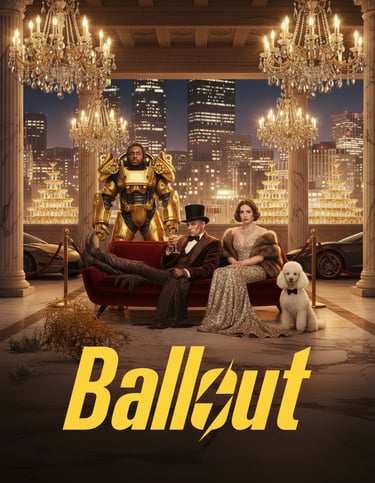
The Pedestal of Peril
In the world of Amazon’s Fallout, the tagline for Vault-Tec is "Prepare for the Future," a sentiment that has leapfrogged from the screen directly into the portfolios of the ultra-wealthy. The show portrays a world of "haves and have-nots" where the gentle denizens of luxury fallout shelters eventually face an incredibly complex, gleefully weird, and highly violent universe. Today’s real estate market is increasingly betting on the "haves" staying underground longer as a radical transformation takes place. Disaster preparedness has transitioned from a fringe subculture to an aspirational investment. While doomsday preppers were once seen as an oddity in peacetime, their preparations no longer seem silly when world leaders begin sabre-rattling with nukes.
The numbers reflect this shift in the macro environment. The market for U.S. bomb and fallout shelters is projected to grow from roughly $140 million today to over $175 million by 2030. Globally, the broader underground construction market was already valued at $3.2 billion in 2024. This surge is fueled by a confluence of geopolitical instability, pandemic anxiety, and a relentless cycle of "black swan" events. For many affluent individuals, buying a hardened concrete sanctuary feels like a legitimate strategy rather than just a "band-aid" like buying iodine tablets.
The Real-World Vault-Tec Inventory
Just as Lucy MacLean’s life in Vault 33 was defined by comfort, real-world developments like Vivos xPoint in South Dakota offer "tiny arks of civilization" spread across 46 square kilometers. For $45,000, you get a concrete shell in a former U.S. Army base, though outfitting it to be "spectacularly cushy" is where the real capital is deployed. Meanwhile, the Survival Condo project in Kansas repurposes decommissioned Atlas "F" missile silos into 15−floor−deep luxury towers where "penthouses" are actually inverted, placing you closer to the earth’s core for $4.5 million. These facilities feature swimming pools, rock climbing walls, and even aquaponic farms, mimicking the self-sustaining environments seen in the show.
Firms like Atlas Survival Shelters are rebranding bunkers as the "Bugatti of apocalypse insurance," moving away from the "musty relic" image of the 1950s. These "Platinum Series" builds feature AR500 bulletproof doors, Swiss-engineered air filtration, and 90-degree stairwell geometry designed to reduce gamma radiation. One featured build even includes a mudroom and ceramic-tiled showers, making the interior look more like a minimalist New York loft than a Cold War shelter. The goal is to ensure survival can be comfortable, even stylish, for those who can afford the average $500,000 price tag for a fully outfitted unit.
The Billionaire Lifeboat
The show's theme of privilege is echoed by the mass migration of tech billionaires into the "lifeboat" of New Zealand or secret compounds in Hawaii. Mark Zuckerberg is reportedly building a Hawaii compound costing in excess of $270 million, complete with at least 30 bedrooms and a massive underground component. For these high-net-worth individuals, bunkers are being treated as a viable long-term asset class, placed alongside art and crypto in portfolio advisories. The amenities are staggering, including "fake windows" with live video feeds showing birds and sunsets to preserve the circadian rhythms of residents who don't know how long they will be down there.
However, just as the show explores the dark conspiracies of those in power, real-world billionaires have bombarded advisors with questions on how to maintain control of security forces once money becomes worthless. Some have even considered using special combination locks on the food supply or disciplinary collars on guards, a chilling parallel to the more "gleefully weird" aspects of the Fallout universe. Experts like Douglas Rushkoff argue that this mindset ignores the reality that long-term survival is more about community than confinement.
The Calculus of Utility
We must apply a dose of second-level thinking to these "silver bullet" investments. Critics argue that bunkers create a "false perception of survivability" and ignore the "Day 100" reality. While a bunker might protect you on Day 1, it cannot mitigate the lethal environmental meltdowns of nearby power plants that may occur while you are trapped inside on Day 100. Furthermore, the transition to underground living has significant psychological impacts, as the "denial" phase of a crisis eventually gives way to the "capitulation" of a confined existence.
There is also the challenge of neighbor risk; Survival Condo screens applicants for criminal backgrounds and seeks people with "good values" and financial resources to participate in shared tasks. Yet, even with the best-vetted neighbors, a bunch of people trapped in a small space with limited supplies and an indoor shooting range is a scenario where much could go wrong. Ultimately, the market is driven by the logic that "it’s better to have it and not need it than to need it and not have it."
Conclusion: The High Cost of the Apex Predator
The market for U.S. bomb and fallout shelters is currently witnessing a massive influx of capital, with demand increasing over 300% since 2020. This reflects a world where risk aversion is rising and the "credit window" for safety is wide open. However, the sobering skepticism of experts remains: a bunker provides psychological assurance, but it may not provide a sustainable future in an all-out nuclear event. As the character Bud Askins notes in the show, "Time is the apex predator," and right now, the smart money is buying as much of it as possible beneath the surface.
Whether these bunkers are the future of peace of mind or merely a pricey panic room for the elite is a question only history will answer. For now, they represent the ultimate contrarian hedge: an investment that performs best when the rest of the world performs its worst. If you’re going to watch the end of the world on a live-feed "fake window," wouldn't you rather do it from a ceramic-tiled shower? Vault-Tec would certainly agree.
For further discussions, inquiries or to delve deeper into this analysis, please feel free to get in touch.