M11_The Day That NYC Couldn't Stay Still
New York City real estate is defying the “Mamdani doom” narrative, with post‑election sales and luxury contracts rising even as tenant‑centric policies and rent‑freeze rhetoric dominate headlines. Despite record‑high Manhattan rents, cash‑buyer strength, shrinking Queens inventory, and persistent global demand suggest NYC remains a long‑term winner—if investors adapt strategies to a harsher regulatory climate instead of joining the selling panic.
Martin O. W. DuPain
1/2/20263 min read
The Catalyst for Change
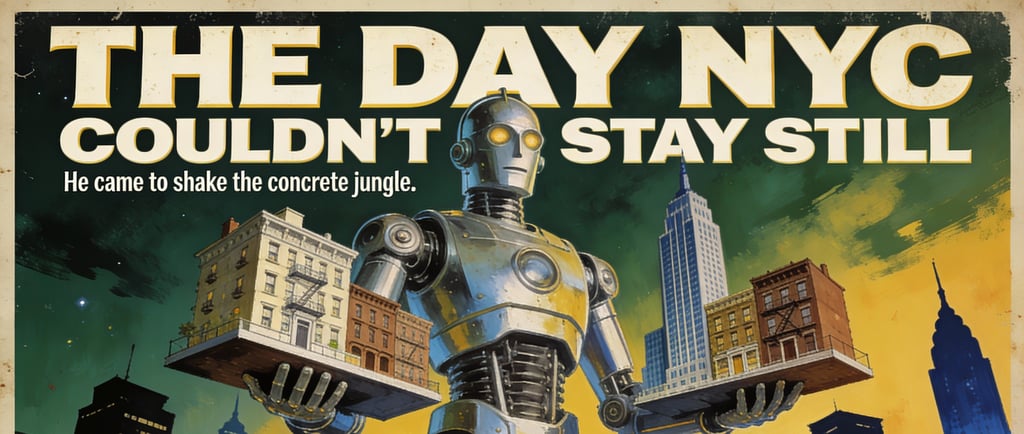
In the 1951 classic The Day the Earth Stood Still, remade in 2008 starring Keanu Reeves and Jennifer Connelly, an alien named Klaatu (Keanu) arrives on Earth with a message: humans must change their ways or face obliteration. There is a pivotal moment when Helen (Connelly) realizes the alien isn’t here to save humanity—he is here to save the planet from humanity. She argues that humans don’t change when it’s easy; they change only when they are forced to change.
As we stand at the threshold of 2026, staring down the barrel of a shotgun on the heels of our new mayor’s swearing-in ceremony, it’s clear that New York City has reached that point. The existential threat has arrived in City Hall in the form of Zohran Mamdani, the city’s 111th mayor. A 34-year-old democratic socialist, Mamdani’s victory was powered by a surge in young voters and a platform focused on making the city "relentlessly" affordable. Like Klaatu, his mission is to save the city, but unlike the alien, he seems to have no hope of compassion and understanding for the individuals who have traditionally powered its high-end real estate and finance sectors.
The Impending Sea Change
We are witnessing what Howard Marks, Oak Tree Capital, might call a sea change, a radical transformation in the environment that mandates a complete review of our investment strategies. For decades, the "tether between work and home" was short, keeping the finance sector firmly anchored in Manhattan. However, as Jonathan Miller of Housing Notes has noted, that tether has become "infinitely longer."
External voices, like David Sacks, US AI & Crypto Czar and Chairman of the President’s Council of Advisors on Science and Technology and host of the podcast ALL-IN, suggest that because of the shift toward socialism, the finance sector will move to Miami and the tech sector will migrate to Texas. This narrative of a "wealth exodus" sparked significant fear during the election cycle. This city, like many others around the US, faces a binary choice: sink or swim. If the tax base collapses and the rich flee, some fear the city will revert to a "tragic, collapsing, impoverished hellscape" reminiscent of the 1970s.
The Data vs. The Narrative
Applying second-level thinking requires us to look past these surface-level fears. First-level thinkers see a socialist mayor and sell their holdings in a panic. Second-level thinkers ask: What does the data actually say?
Surprisingly, the actual market data following the election refutes the narrative of a mass decamping. In November 2025, total residential sales in NYC were up 20.5% year-over-year. More importantly, the luxury segment—those properties above $4 million targeted by Mamdani's proposed 2% flat tax—showed even greater strength, with sales increasing by 43.1%. As Jonathan Miller pointed out, "...anecdotes are not data," and the commitment to the city remains remarkably high. Even titans like Ken Griffin of Citadel are breaking ground on massive new office projects, signaling that "...no one is calling the moving trucks."
The Housing Reality
While the political theater plays out, the fundamental "negative art" of the real estate market remains centered on inventory.
The Inventory Crisis: In Queens, listing inventory plummeted 23.9% in late 2025, forcing median sales prices to record highs even as sales volume dipped.
The Cash Buffer: Manhattan remains a "...fortress of cash-buyer stability," with cash buyers representing two-thirds of all sales and 90% of transactions above $3 million. This cohort remains largely insulated from the "party's over" spike in mortgage rates, which have hovered near 7% for the majority of 2025.
The Affordability Threshold: We are approaching a tipping point where Manhattan becomes inaccessible for most renters, with median rents hitting $4,000.
Conclusion: Sink or Swim
The Mamdani administration represents a shift toward tenant-centric policies, including proposed rent freezes and the expansion of public housing. While this creates "...uncomfortable idiosyncratic" conditions for some investors, the underlying demand for New York City residency appears stronger than the fear of regulation.
We may be "staring down the barrel of a shotgun," but history shows that the death of NYC has been greatly exaggerated many times before. The city will not stay still. It is a weighing machine that, in the long run, prizes the unique value of being at the center of the world.
My strategy for 2026 is to move forward, but with caution, what NY’ers do already do best. We must accept that the old rules have changed, but we refuse to join the "selling panic." Politics may be at a standstill, but New York City simply doesn’t know how.
For further discussions, inquiries or to delve deeper into this analysis, please feel free to get in touch.